Build Agentic AI Systems That Actually Ship: Lessons from the Enterprise Front Lines

Over the past two years, the AI community has made tremendous strides in agentic workflows. We’ve moved from simple prompt chains to complex, multi-agent frameworks capable of reasoning, planning, and executing tool calls.
Yet, when engineering teams try to take these agentic proofs-of-concept into production, they run into a hard wall.
An agent that performs magically in a staging environment can quickly become a liability in production when touching real systems of record—customer databases, financial ledgers, and payment gateways. Unexpected retry loops double-refund customers, credential sprawl exposes sensitive APIs, and prompt tweaks cause silent regressions across unmonitored edge cases.
Building an agentic system that actually ships requires shifting our perspective: An agentic application interacting with multiple enterprise tools is no longer just an LLM orchestration problem—it is a distributed systems problem.
Here is a deep dive into the architectural patterns, governance frameworks, and evaluation strategies required to ship enterprise-grade agentic systems safely.
1. The Enterprise Tool Gateway: Decoupling Proposal from Execution
In early agent prototypes, developers typically pass raw API keys directly into the agent’s execution environment. While fast and easy, this leads to credential sprawl, lack of workload identity, unmonitored retry loops, and zero audit trails.
To solve this, enterprise architecture requires a strict separation of concerns governed by a single guiding principle:
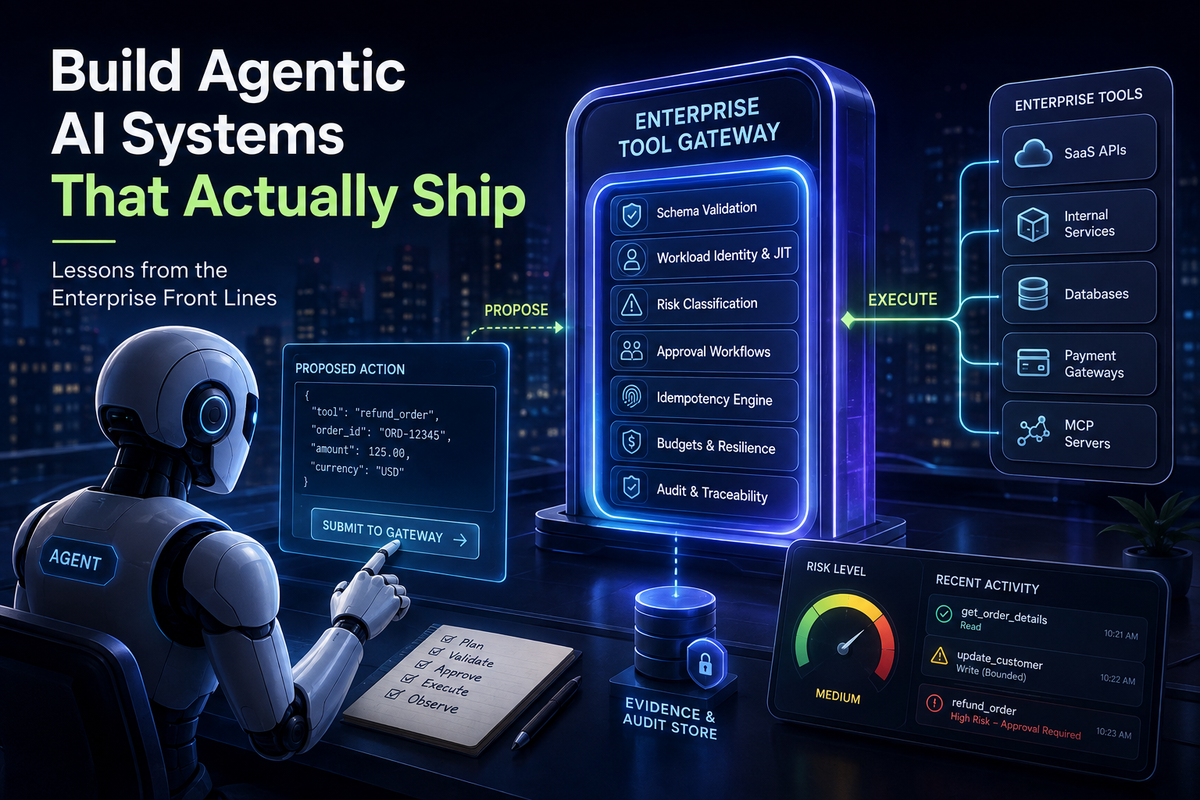
The model proposes the action. The gateway decides whether, when, and how safely it executes.
                 ┌───────────────────────────┐
                 │   Enterprise Tool Gateway │
                 │ ┌───────────────────────┐ │
                 │ │ Schema Validation      ││
                 │ │ Workload Identity & JIT││
[ Agent ] ──────>│ │ Risk Classification    ││────> [ Enterprise Tools ]
                 │ │ Approval Workflows     ││         (MCP, REST, DBs)
                 │ │ Idempotency Engine     ││
                 │ │ Budgets & Resilience   ││
                 │ └───────────────────────┘ │
                 └─────────────┬─────────────┘
                               │
                               ▼
                   [ Evidence & Audit Store ]
The 12 Strategic Gateway Concerns
- Tool Registry & Capability Discovery: A unified, versioned catalog of all callable capabilities (including schemas, ownership, and risk tiers). Agents discover tools dynamically rather than relying on hardcoded endpoints.
- Schema & Argument Validation: Never trust LLM-generated arguments by default. The gateway validates types, enums, formats, and basic business logic bounds (e.g., rejecting a $5,000 refund request on a $50 order) before downstream execution.
- Workload & User Identity: Every tool call must explicitly answer four questions before running:
- Which Agent? (Workload identity, service version)
- Which User? (Human on whose behalf the action runs)
- Which Tenant? (Multi-tenant data isolation boundary)
- Which Scope? (Granular, action-specific permission)
- Just-In-Time (JIT) Credential Brokering: Eliminates permanent, high-privilege keys in agent environments. The gateway brokers short-lived, narrowly scoped tokens with minimal Time-To-Live windows (e.g., 5 minutes for read actions, 1 minute for write operations).
- Risk Classification Engine: Categorizes capabilities upfront:
- Low Risk (Read): Auto-approved and logged.
- Medium Risk (Bounded Write): Auto-approved within preset budget thresholds.
- High Risk / Irreversible (Refunds, Deletions): Intercepted for mandatory approval.
- Human Approval as Infrastructure: Centralizes human-in-the-loop gates at the gateway layer, enforcing consistent approval policies across all teams while recording mandatory audit evidence (who approved, when, and justification).
- Budgets & Hard Ceilings: Enforces strict execution caps—invocation limits per task/session to prevent runaway LLM retry loops, and monetary spend ceilings on third-party APIs.
- Idempotency & Deduplication: Generates cryptographic hashes of the request context (
tenant + user + tool_arguments + transaction_id). If an agent retries an action, the gateway serves the cached result rather than executing a duplicate refund. - Resilience Engineering: Applies bounded timeouts, exponential backoffs, circuit breakers (failing fast after N consecutive downstream errors), and bulkheads to protect downstream connection pools.
- Dead-Letter Paths: Quarantines malformed, unprocessable, or perpetually failing requests for human inspection rather than spinning in infinite loops.
- Traceability & Evidence Store: Writes immutable, tamper-evident audit logs independently of standard application logging stacks for regulatory compliance.
- Protocol Adapters: Normalizes interactions across REST APIs, internal gRPC microservices, databases, and Model Context Protocol (MCP) servers.
Note on MCP vs. Tool Gateway: While the Model Context Protocol (MCP) provides a standard transport mechanism for exposing capability tools, MCP is not a gateway. It does not natively enforce enterprise policy checks, JIT token generation, approval workflows, idempotency hashing, or budget management—these critical capabilities must reside inside the Tool Gateway.
2. Distributed Systems Patterns for Multi-Tool Agents
When an agent orchestrates tasks across multiple microservices, individual services can and will fail independently. Translating classic Enterprise Integration Patterns (EIP) to agentic systems ensures robustness:
[ User Intent ] ──> [ Content-Based Router ]
                           │
             ┌─────────────┴─────────────┐
             ▼                           ▼
   [ Splitter / Aggregator ]     [ Routing Slip ]
   (Parallel Tool Execution)    (Sequential Plan)
             │                           │
             └─────────────┬─────────────┘
                           │
                           ▼
             [ Saga Compensating Actions ]
           (Roll-Forward Business Recovery)
- Tool Granularity:
- Coarse-Grained Tools: Encapsulate fixed multi-step workflows into deterministic, single-call capabilities (e.g.,
process_return). Recommended for high-stakes, strict operations. - Fine-Grained Tools: Atomic, composable tools (e.g.,
check_stock,reserve_item). High flexibility, but increases the risk of tool-selection errors and latency.
- Coarse-Grained Tools: Encapsulate fixed multi-step workflows into deterministic, single-call capabilities (e.g.,
- Content-Based Routing: Routes agent requests dynamically based on intent, risk tier, and tenant context.
- Splitter & Aggregator: Splits complex user requests into parallel tool executions (e.g., checking inventory across three regional fulfillment centers) and aggregates the outcomes into a single response.
- Correlation Identifiers: Threads a single execution tracing ID across all prompt runs, system logs, and downstream API headers.
- Control Bus (Kill Switch): Provides an out-of-band management channel to pause, inspect, or kill running agent threads in real time.
Failure Handling: The Saga Pattern & Compensating Actions
Because agentic workflows cross external service boundaries, traditional relational database rollbacks (ROLLBACK TRANSACTION) are impossible.
Instead, systems must undo forward using the Saga Pattern:
- When a multi-step operation fails at step 3, execute explicit, reverse business logic for previously completed steps.
- Example: You do not delete an issued invoice; you issue an explicit credit note.
- Ordering Rule: Design workflows so that the steps most likely to fail and hardest to compensate come first (e.g., authorize payment early; trigger physical shipping fulfillment last).
3. Evaluation & Measurement: Beyond "Eyeballing" Outputs
The most dangerous anti-pattern in agentic engineering is evaluating system quality by manually reviewing a handful of output prompts. Prompt updates and model upgrades introduce silent logic regressions if not governed by an automated testing harness.
                         ┌─────────────────────────────┐
                         │    Golden Data Benchmark    │
                         └──────────────┬──────────────┘
                                        │
             ┌──────────────────────────┴───────────────────────┐
             ▼                                                  ▼
 [ Component Level Metrics ]                     [ System Level Metrics ]
 • Tool Recall (Did it call required tools?)       • Task Success Rate
 • Tool Precision (Avoid extra calls?)             • End-to-End Latency (P95/P99)
 • Parameter Accuracy (Exact arguments correct?)   • Token & API Cost Spend
Component-Level Evaluation Metrics
Rather than relying solely on expensive "LLM-as-a-judge" evaluations for every test case, use deterministic component metrics:
- Tool Recall: Did the agent invoke all necessary tools required to fulfill the request?
- Tool Precision: Did the agent avoid making unnecessary or redundant tool calls?
- Parameter Accuracy: Were extracted parameters ground-truth accurate? (e.g., extracting
$19.99for a single damaged item instead of$39.99for the entire order total). - Semantic Text Measures: Using embedding distances, BERTScore, or targeted phrase recall for free-text validation where strict string equality isn't applicable.
Cultivating Golden Data Sets
Evaluation sets are living specifications. Scale them continuously through three channels:
- SWE Benchmarks: Hand-crafted ground-truth scenarios developed by domain experts.
- Production Failure Mining: Extracting real-world user edge cases and ambiguous API failure traces directly from production logs.
- Synthetic Edge Cases: Using adversarial prompting, intent blending, and counterfactual editing (changing key variables to test if logic collapses) to stress-test system boundaries.
4. Key Takeaways for Engineering Teams
- Decouple Action Proposal from Execution: Enforce an Enterprise Tool Gateway between the LLM runtime and your systems of record.
- Design for Partial Failures: Treat multi-tool execution as a distributed system. Implement Saga compensating actions for forward failure recovery.
- Automate CI/CD Deployment Gates: Never ship changes based on manual prompt inspection. Gate production releases on strict baselines for Tool Recall, Parameter Accuracy, and Task Success Rates.
- Fail Gracefully: Under ambiguous or malformed inputs, agents should clarify, decline, or escalate safely rather than crashing or leaking sensitive context.
By pairing the adaptive reasoning of agentic AI with the proven discipline of enterprise systems engineering, organizations can move beyond promising demos and deploy reliable, auditable, production-grade AI systems.