Demystifying Database Replication: A Primer for New Engineers

If you spend enough time building backend systems, you'll eventually hit a wall where a single database server just isn't enough. Maybe your read traffic is spiking, or maybe you're losing sleep over what happens if that one server's motherboard fries at 3 AM.
The solution is replication: keeping a copy of the exact same data on multiple machines connected via a network. It sounds simple in theory—much like how I configure my camera to write long-exposure shots to two memory cards simultaneously just in case one corrupts. But in distributed systems, network latency and unpredictable node failures make this deceptively hard.
If you're new to distributed architecture, the landscape can feel overwhelming. Let's break down the three primary ways we handle replication in modern databases, stripping away the academic jargon.
1. Single-Leader: The "Follow the Leader" Model
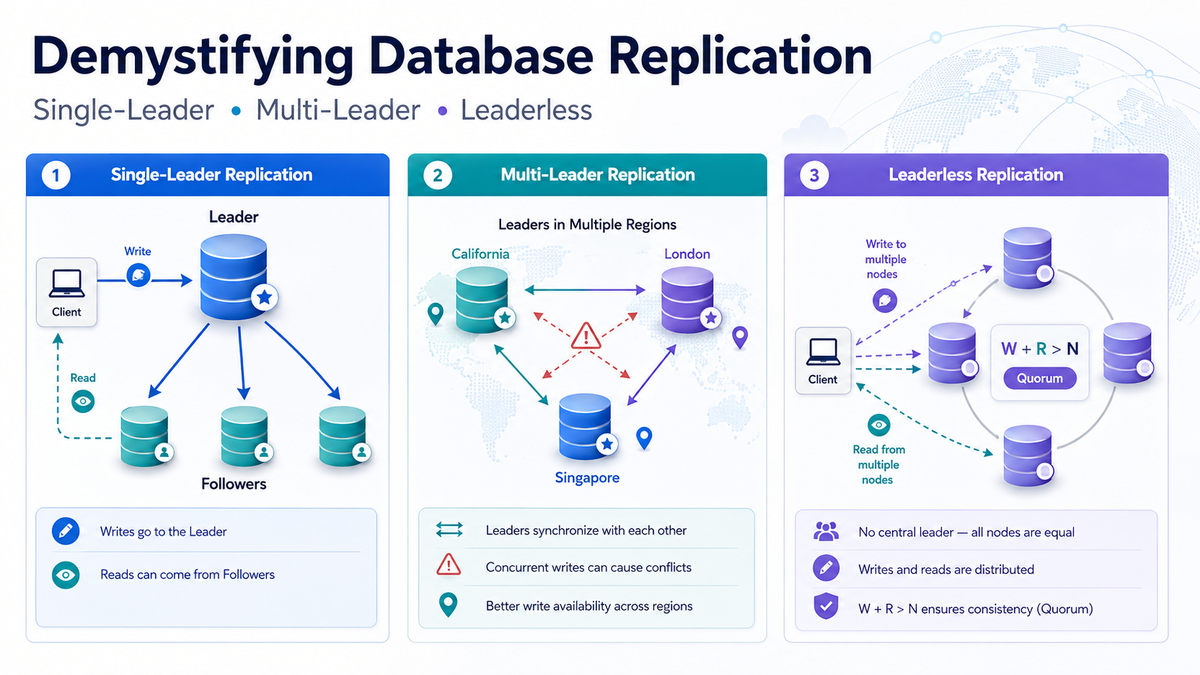
This is the most common setup. Think of PostgreSQL or MySQL in their default configurations. You have one "leader" node and several "follower" nodes.
- How it works: All writes (inserts, updates, deletes) must go to the leader. The leader saves the data locally and then streams the changes to the followers. You can scale out your read traffic by querying any of the followers, but you can only write to the leader.
- The Catch: You have to choose between synchronous and asynchronous replication. If you make it synchronous, the leader won't confirm a write to the user until the followers also safely store it. This guarantees no data loss, but if one follower has a network hiccup, your whole system stalls. If you make it asynchronous, the system is blazing fast, but if the leader crashes before sending the data to followers, those recent writes are gone forever.
- When to use it: When you need a straightforward architecture and your application does a lot more reading than writing.
2. Multi-Leader: The Collaborative Committee
What happens if you have users in California and users in London? Routing all global writes to a single leader on the West Coast means your European users will suffer terrible latency.
- How it works: You set up a leader in each datacenter. Each leader accepts writes from local users and then asynchronously forwards those changes to the other leaders behind the scenes.
- The Catch: Conflicts. Imagine a user in California and a user in London update the exact same record at the same millisecond. Which write wins? Resolving these conflicts is notoriously difficult. You either need complex application-level code to merge the changes, or you rely on blunt database rules like "last write wins" (which effectively deletes one of the updates).
- When to use it: Multi-datacenter deployments, or applications that need to work offline and sync up later (like a collaborative text editor or a mobile calendar app).
3. Leaderless: The Voting Democracy
Popularized by Amazon's Dynamo and used by databases like Cassandra, this model throws the concept of a central "leader" out the window.
- How it works: Any client can send a write to any replica in the cluster. To ensure data isn't lost, the client sends the write to several nodes simultaneously. To read, it queries several nodes at once and uses version numbers to determine which response contains the freshest data.
- The Catch: It relies on a concept called "Quorum." The golden rule is $W + R > N$. If you have 3 nodes in total ($N=3$), you might require writes to be confirmed by 2 nodes ($W=2$) and reads to query 2 nodes ($R=2$). Since $2 + 2 > 3$, your read query is guaranteed to hit at least one node that saw the latest write. However, dealing with nodes that crash and come back online with stale data requires constant background maintenance to keep the cluster healthy.
- When to use it: Systems that demand massive availability and can tolerate slightly stale reads during brief network partitions.
Replication forces us to pick our poisons. Do we want absolute consistency at the cost of availability when the network gets flaky? Or do we want the system to always accept writes, even if it means untangling conflicts later?
Next time you are sketching out a new service architecture, take a hard look at your read/write ratios and your actual tolerance for data loss. What specific availability guarantees does your current project require?