When the Source of Truth Fails: A Kafka Schema Registry Outage Post-Mortem

Apache Kafka combined with Avro serialization is the gold standard for high-throughput, structured data streaming. By stripping out repetitive schema definitions and relying on a centralized registry, engineering teams can save massive amounts of network bandwidth and storage.
But what happens when that centralized registry suddenly vanishes during a massive traffic spike?
A financial engineering team I know recently dealt with exactly this scenario: The Microservice Panic. A localized network partition took down their Schema Registry, turning a highly efficient Kafka cluster into an unreadable firehose of raw binary data.
Here is a breakdown of how a single point of failure (SPOF) brought a high-frequency financial ledger to its knees, and the architectural patterns required to prevent it.
The System Profile: The Kafka-Avro Ecosystem
The team maintains a high-frequency financial ledger that streams transaction notifications across 40 independent consumer microservices. To handle the massive volume, they leverage Apache Kafka.
For data serialization, they rely on Apache Avro. To ensure strict data governance and resolve schema versions without embedding heavy text strings into every single message, the cluster utilizes the Confluent Schema Registry.
The workflow is standard for this architecture:
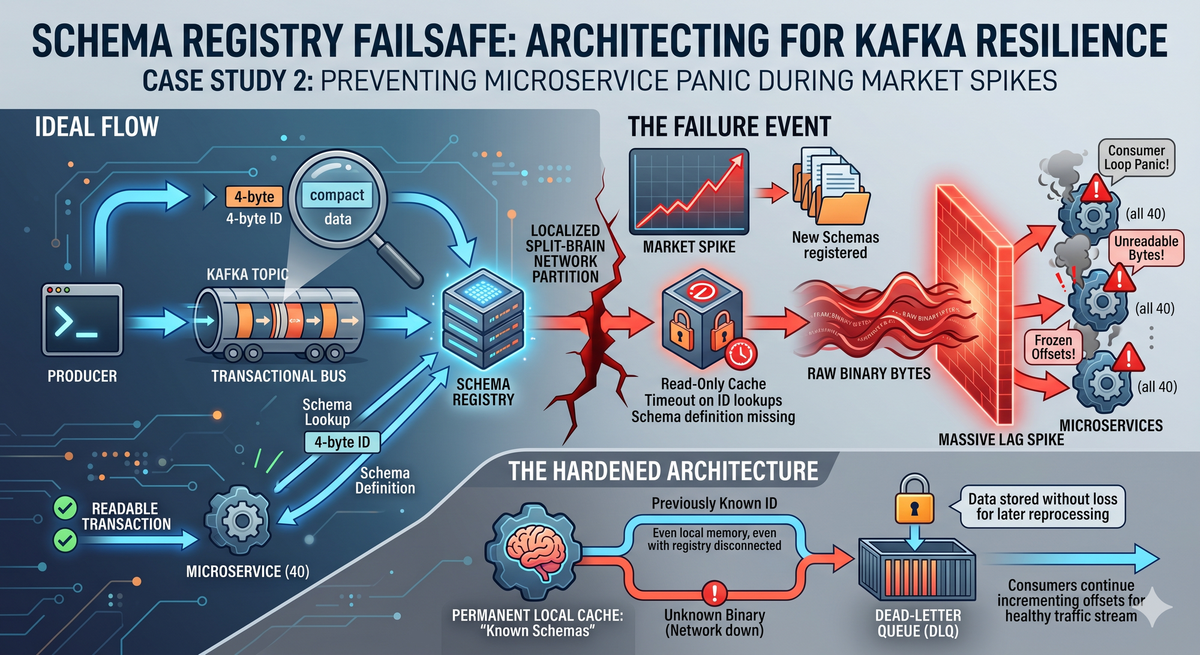
- A producer registers a schema and attaches a tiny 4-byte schema ID to the outbound message.
- The message hits the Kafka topic as a compact binary payload.
- A consumer pulls the message, reads the 4-byte ID, fetches the corresponding schema from the Schema Registry, and deserializes the payload back into a usable object.
The Failure: Split-Brain and The Microservice Panic
The system was designed for scale, but it encountered a perfect storm during an intense market spike. Coinciding with the traffic surge, a new deployment registered a wave of updated schemas.
Under the heavy load, the Schema Registry experienced a localized split-brain network partition. The registry's internal cache locked into a read-only state, causing all new schema version checks to fail with timeouts.
This created a catastrophic cascading failure across the architecture:
- Unreadable Bytes: Downstream consumer services began pulling messages from Kafka, but because they couldn't connect to the registry to fetch the new schemas, they were left holding raw, unparsable binary bytes.
- The Panic Loop: Without the schema definition, the consumer loops panicked and threw deserialization exceptions.
- Frozen Offsets: Because the consumers couldn't process the messages, they refused to acknowledge them or commit their offsets. The microservices essentially froze in place, repeatedly trying and failing to read the exact same unparsable messages.
- Massive Lag Spike: Within minutes, this triggered a massive lag spike across the core transactional bus, halting the financial ledger.
The Fix: Engineering for Registry Resilience
The core issue wasn't Kafka, and it wasn't Avro—it was treating a centralized schema registry as an infallible utility rather than a potential Single Point of Failure (SPOF) in an ultra-low-latency environment.
To harden the architecture, the team implemented two critical defensive patterns:
1. Permanent Local Caching
Microservices can no longer rely on real-time registry lookups for every new schema ID. The system must implement robust, permanent local caching of schema data definitions in memory. If the registry goes down, the consumers must be able to continue parsing any messages utilizing previously known schemas without making a network hop.
2. Dead-Letter Queues (DLQs) for Ambiguous Binary
A consumer loop must never freeze the pipeline because it encounters a payload it cannot deserialize. The team instituted a strict DLQ mechanism. When a consumer encounters ambiguous binary packets and cannot reach the registry after a set number of retries, it routes the raw payload directly to a secure dead-letter queue.
This ensures the ambiguous data is stored safely without data loss during the network failure, while allowing the consumer to increment its offset and continue processing the rest of the healthy transaction stream. Once the registry connection is restored, the DLQ can be reprocessed.
The Takeaway
Centralizing your schema management is fantastic for governance and bandwidth, but it introduces a critical, often-overlooked dependency. In distributed streaming environments, your consumers must be designed to survive the temporary loss of their external dependencies. If they can't deserialize the data, they need a safe place to put it—because stopping the stream is never an option.