The Silent Data Killer: How a Rolling Deployment Evicted E-Commerce Records

If you run high-traffic enterprise systems, zero-downtime deployments aren’t a luxury—they are a strict requirement. Engineering teams rely on rolling deployments to seamlessly shift traffic from Legacy (Version 1) to New (Version 2) without dropping a single user request.
But what happens when Version 1 and Version 2 are forced to talk to the same database at the exact same time?
Recently, a platform engineering team I know encountered a notorious distributed systems anomaly: The Multi-Generation Record Eviction. It didn’t trigger any massive alarms, it didn’t crash any pods, and it didn’t spike their error rates. Instead, it resulted in the silent, systematic deletion of production data.
Here is a breakdown of how their object-relational mapping (ORM) turned into a data-clobbering machine, and the architectural patterns they implemented to fix it.
The System Profile: A Tale of Two Versions
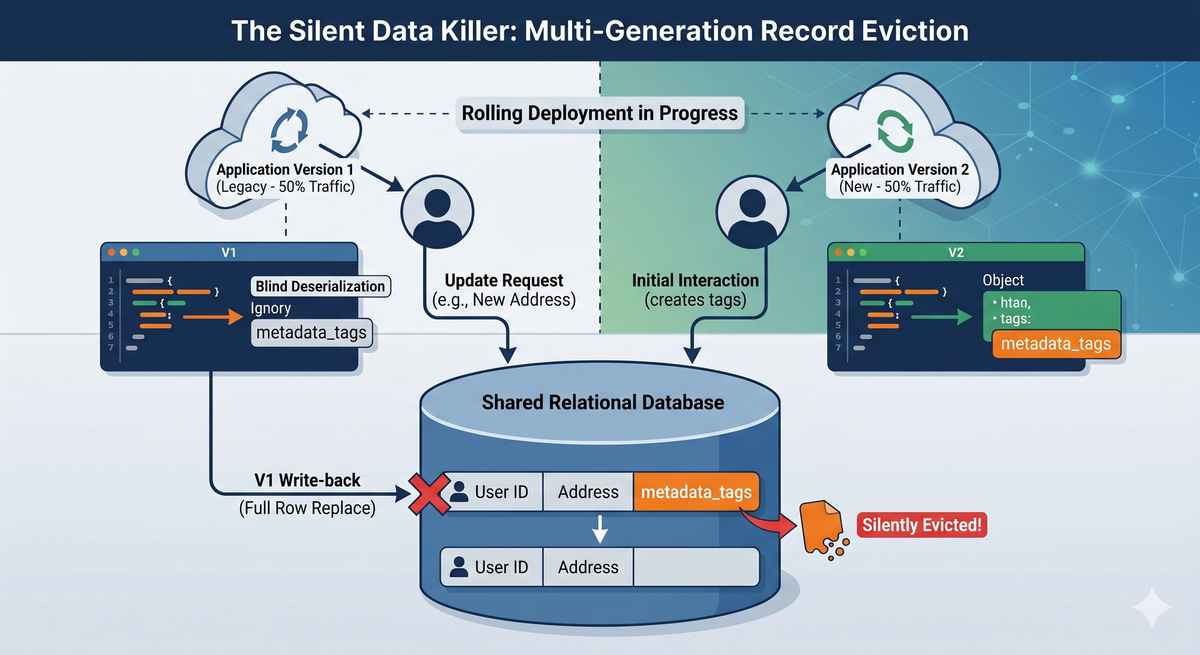
The team's enterprise retail platform was in the middle of a standard two-week rolling deployment. Because of the sheer size of the cluster, service nodes running Version 1 and Version 2 were operating simultaneously, both hitting a shared relational database cluster.
The change was simple: Version 2 introduced an optional tracking object called metadata_tags to user profiles. This JSON blob was designed to capture rich marketing parameters, attribution sources, and campaign IDs to help the analytics teams.
Everything looked green on the dashboards. Version 2 nodes were happily writing metadata_tags to the database. But a few days in, the marketing team noticed a disturbing trend: users who had complete marketing profiles suddenly had their tags wiped clean.
The Failure: The "Read-Modify-Write" Trap
To understand the bug, we have to trace the exact journey of a single user navigating a multi-version load balancer:
- The V2 Interaction: A user interacts with a Version 2 node. The node captures the session and generates a profile containing the new
metadata_tags. The database saves it perfectly. - The V1 Interaction: Later that day, the user updates their shipping address on a mobile client. The load balancer routes this request to an older Version 1 node.
- The Blind Deserialization: The Version 1 node queries the database and deserializes the user record into its local class definition. Because Version 1 was written months ago, it has no idea what
metadata_tagsare. It practices strict schema binding, completely ignoring the column and dropping it from its in-memory object. - The Silent Eviction: The user updates their address. The V1 node saves the updated record back to the database. Because the application's ORM defaults to a full-row "read-modify-write" cycle, it issues an
UPDATEstatement for every column based on its current memory state.
The result? The Version 1 node overwrites the entire row, silently evicting the marketing tags created by Version 2.
Why This Happens
This bug is a classic collision of two factors:
- Intolerant Readers: The legacy application objects lacked forward compatibility. They could not gracefully handle future state or unrecognized payload attributes.
- Full-Row Mutations: The ORM treated the database as a dumb storage locker for the application's memory, rather than executing precise, localized state mutations.
The Fix: Engineering for Forward Compatibility
To ensure this never happens again, the team realized their application code had to be defensive against multi-version database access. They instituted two mandatory engineering standards across their data layer:
1. The Tolerant Reader (Fallback Buffers)
Application objects must never "blind-deserialize" database rows. If an application pulls a row and encounters an unrecognized column or JSON key, it must not drop it. Instead, the serialization layer must map unrecognized attributes into a generic fallback buffer (e.g., an _unmapped_fields dictionary).
When the application saves the record back, it merges its known fields with the fallback buffer, ensuring that data created by newer versions passes through the legacy system unharmed.
2. Strict Field-Level Updates
Full-row replacements (UPDATE users SET col1=A, col2=B, col3=C...) are now an anti-pattern for their core entities. Database writes must be restricted to isolated, field-level updates.
If a user updates their shipping address, the ORM or query builder must generate a precise UPDATE users SET shipping_address = ? WHERE id = ?. Because the application never attempts to overwrite the metadata_tags column, the newer data remains perfectly safe, regardless of which node executes the write.
The Takeaway
Rolling deployments are effectively a distributed systems time machine where the past and the future exist at the exact same time.
If services share a database, code cannot assume it is the only actor mutating that state. By designing tolerant readers and enforcing partial updates, teams can decouple schema evolution from the deployment lifecycle—and keep sensitive data right where it belongs.