Demystifying OLAP Storage: Scaling Beyond the Limits of Transactional Databases

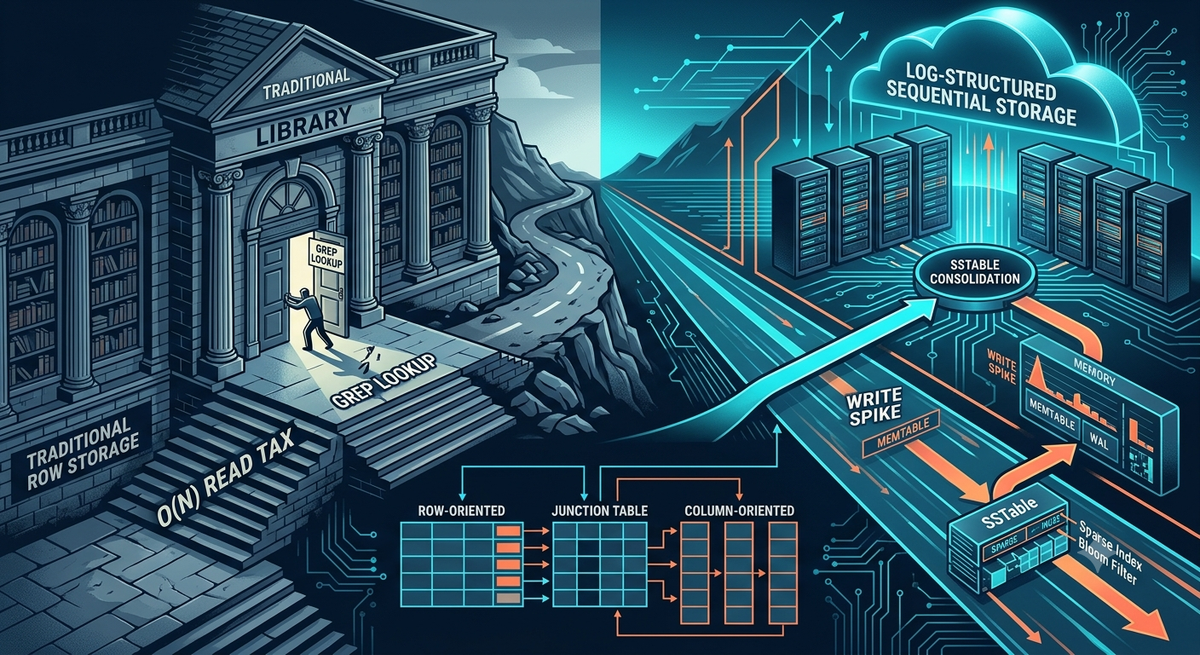
In the landscape of modern data engineering, developers often encounter a painful architectural crossroads. We begin our system designs using familiar, robust relational patterns. Our applications process high-concurrency checkouts, track real-time operational states, and handle user profile configurations seamlessly. This is the comfort zone of OLTP (Online Transaction Processing)—an ecosystem optimized for short-lived, pinpoint requests that fetch or mutate a tiny handful of rows via primary or secondary keys.
But as an enterprise scales, the business questions pivot from operational lookups ("What did user X purchase?") to deep, macro-level analytical aggregation ("What are our seasonal price trends over 5 years across 500 million transaction entries?").
Attempting to force a traditional, row-oriented database engine to handle both of these workloads simultaneously leads directly to what systems architects call The Operational Nightmare. Deep analytical loops clog execution memory, flood the disk I/O channels, evict hot operational pages from the operating system cache, and cause concurrent production checkouts to stall.
To scale safely, we must step past the boundaries of transactional processing and embrace the mechanical realities of OLAP (Online Analytical Processing) and column-oriented architectures.
Case Study 1: The Write-Amortization Trap
The Conflict of Asymmetric Performance
Consider an agricultural logistics and marketplace platform tracking continuous real-time IoT sensor telemetry streams (soil moisture levels, ambient greenhouse humidity, refrigerated cargo truck temperatures) across 10,000 active farmlands. This system produces an unrelenting burst of 100,000 write operations per second.
To optimize for this read-heavy, bulk analytical aggregation space while still accepting transactional inserts, columnar databases deploy a log-structured batching layout: incoming updates are buffered horizontally as rows in a memory pool, and background worker threads sequentially flush, pivot, and compress them into vertical columns on disk later.
But what happens when an unexpected, sustained write torrent hits the system? The ingestion rate vastly outpaces the background transformation throughput. The in-memory row buffer swells, threatening to trigger out-of-memory (OOM) crashes, intense garbage collection thrashing, or node evictions.
Engineering the Safety Valves
To keep the write buffer from saturates the memory pool under severe load, architects rely on three primary defensive abstractions:
- Dynamic Micro-Flushing: Instead of waiting for the write buffer to hit its optimal size threshold (e.g., 64MB or 128MB), the engine adaptively shrinks the flush window. It aggressively flushes smaller, non-optimal columnar "micro-segments" or delta files down to disk at tight intervals (e.g., 4MB). This instantly clears the RAM heap but pushes the consolidation debt downstream.
- Disk-Backed Append-Only Spooling: The database decouples the raw ingestion network path from the column-pivot engine by utilizing a highly efficient, sequential on-disk staging log. Incoming data is quickly written to disk as raw rows and immediately acknowledged, while the in-memory layer tracks only lightweight metadata pointers rather than raw payloads.
- API-Layer Circuit Breakers: An application-level guardrail that monitors active JVM heap utilization. If memory bounds are breached, a token-bucket rate limiter throttles or rejects incoming non-critical ingestion events at the API gateway layer before they can pollute the database memory pool.
The Cost of Backpressure
If you choose to protect memory by enforcing hard backpressure—deliberately slowing down or blocking incoming application INSERT operations—you are forcing explicit structural trade-offs across your entire infrastructure:
- Availability vs. Consistency (CAP Realities): Applying backpressure sacrifices Availability to keep the database stable. Upstream microservices or edge proxies will experience cascading timeouts. You aren't eliminating the data debt; you are just shifting the storage burden off the database heap and onto your upstream message brokers or networking buffers.
- Ingest Latency vs. Long-Term Read Performance: If you reject backpressure and opt for Micro-Flushing, your write path stays wide open, but your read path pays a heavy penalty. Instead of executing a highly optimized vector sweep across a few large, beautifully run-length encoded columnar blocks, analytical queries must now open, decompress, and stitch together thousands of fractured micro-segments on disk, turning sequential scans into random block seeks.
- Compute Allocation Competition: Backpressure shifts the system bottleneck from memory exhaustion to CPU/Disk I/O contention. While application threads are forced to wait, the system redirects maximum hardware cores to run intense compression sorting and bitmap generation. Consequently, any simultaneous analytical queries or real-time business dashboards will experience severe performance slowdowns because the CPU is fully consumed by the compaction storm.
Case Study 2: The Vector Nondeterminism Dilemma
The Shift to Probabilistic Lookups
For engineers raised on the deterministic guarantees of relational algebra ($A=A$), transitioning to modern AI retrieval mechanisms like Approximate Nearest Neighbor (ANN) search is a major paradigm shift.
In a traditional database, an index lookup is binary: a record either matches the query predicate or it doesn't. In a vector database, an entry is embedded into a high-dimensional geometric coordinate space. The query returns a set of vectors based on proximity metrics (like cosine similarity or Euclidean distance) navigating through spatial networks like Hierarchical Navigable Small World (HNSW) graphs.
Because ANN algorithms sacrifice absolute accuracy for execution speed, their results are inherently probabilistic and non-deterministic. Index updates, graph re-balancing, or hyperparameter adjustments (like changing the number of probes) can cause identical semantic queries to return subtly different result rankings over time.
Clean Testing and Validation in a Proximity World
To build robust enterprise pipelines on top of non-deterministic engines, software engineers must replace exact-match assertions with statistical validation, regression baselines, and multi-stage verification architecture.
1. Shift from Unit Assertions to Statistical Assertions (Recall Tracking)
You cannot write a test that says: assert results[0].id == expected_id. Instead, you must test for Recall@K or Intersection@K. Create a locked, golden dataset of representative evaluation queries alongside their ground-truth results (calculated via a slow but 100% accurate brute-force flat scan). Your automated CI/CD pipeline executes these queries against the active ANN index and asserts that the overlap between the test results and the ground truth meets a strict statistical threshold:
$$\text{Overlap} = \frac{|\text{ANN Results} \cap \text{Ground Truth}|}{K} \ge 0.95$$
2. Implement Semantic Drift and Regression Guardrails
Every time your embedding model is updated, or your vector graph undergoes a massive background merge/optimization, the spatial coordinates shift. Implement regression testing in your deployment pipeline. Run a standard suite of benchmark queries post-indexing and assert that the cosine similarity distribution or the overall result relevance scores have not degraded beyond an acceptable standard deviation variance compared to the previous production deployment.
3. Decouple Logic via Hybrid Multi-Stage Verification
To protect downstream enterprise business logic from the chaos of raw vector closeness, wrap the probabilistic engine in a multi-stage verification layer:
[User Semantic Query]
         │
         ▼
 ┌────────────────────────────────────────┐
 │ Stage 1: Probabilistic Recall (ANN)    │ ──> Narrows 1B choices to 100 closest vectors
 └────────────────────────────────────────┘
         │
         ▼
 ┌────────────────────────────────────────┐
 │ Stage 2: Deterministic Filtering (SQL) │ ──> Enforces hard limits (status == 'ACTIVE')
 └────────────────────────────────────────┘
         │
         ▼
 ┌────────────────────────────────────────┐
 │ Stage 3: Exact Re-ranking & Execution  │ ──> Run localized, exact distance matching
 └────────────────────────────────────────┘
         │
         ▼
[Verified Downstream Application Logic]
Conclusion: Mastering the Trade-offs
The ultimate takeaway from scaling high-capacity data systems is clear: hardware properties dictate your software choices. There is no magic database engine that satisfies all patterns simultaneously. Optimization is always a game of mastering trade-offs.
Column-oriented data warehouses are beautifully optimized for bulk reading and large aggregations, not real-time streaming transactional inserts. AI vector stores are engineered for conceptual discovery and high-dimensional proximity mapping, not literal equality or absolute relational keys. The true role of the systems architect is to design the abstractions, buffers, and validation guardrails around these engines so that the application layer remains resilient, predictable, and performant under any scale.