Balancing Act: How AI Decides What to Say Next


If you’ve ever used an AI chatbot, you’ve probably marveled at its ability to string words together in a way that feels incredibly human. But behind the scenes, these AI models are constantly fighting a hidden battle: the tug-of-war between making perfect sense and actually being interesting.
A fascinating research paper, verbatim titled "Trading off Diversity and Quality In Natural Language Generation", dives deep into this exact problem. Let's break down what the researchers found, why AI sometimes sounds like a broken record, and how scientists are trying to fix it.
The Core Dilemma: Quality vs. Diversity
Imagine you are at a party and someone asks you a question. You could just say "I don't know" to almost anything. It's grammatically perfect, highly accurate, and completely safe. But if you answer every question that way, you are going to be a terrible conversationalist.
AI faces this exact same problem. Researchers have to optimize for two conflicting goals:
- Quality: The AI's response needs to make logical and grammatical sense. (No gibberish).
- Diversity: The AI needs to be creative, varied, and interesting. (No repeating "I don't know").
If an AI is tasked with translating a document, we care 100% about Quality. But if the AI is writing a story or chatting with you, Diversity becomes incredibly important.
The "Likelihood Trap"
You might think that to get the best AI response, we should just program the computer to always pick the mathematically most "likely" or "safe" sentence it can think of.
The researchers tested this exact theory by having humans rate thousands of AI-generated sentences. They mapped out the results in the paper's Figure 1 below, which shows a scatter plot comparing how "likely" the AI thought a sentence was versus how humans actually rated it.
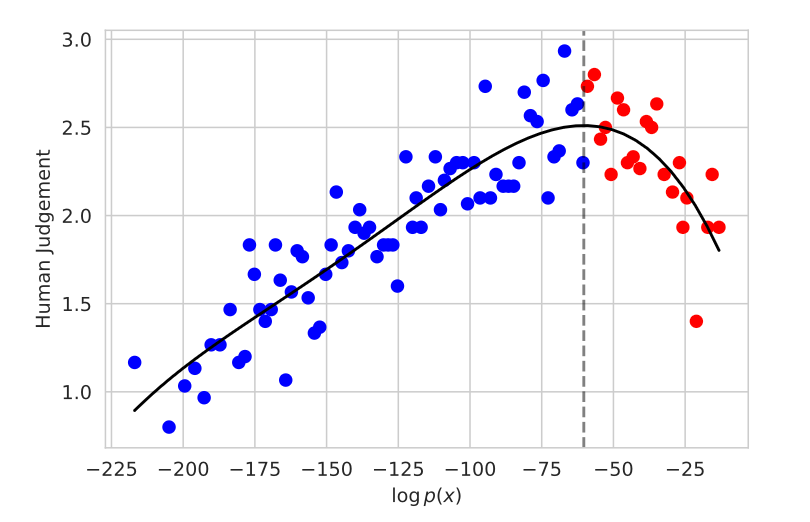
The result? The graph forms an upside-down 'U' shape. At first, as sentences become more mathematically likely, human ratings go up. But eventually, it hits a cliff. The absolute most likely sentences are actually rated terribly by humans.
The researchers call this the "Likelihood Trap." Why does it happen? Because when an AI tries too hard to be safe and predictable, it falls into bizarre, infinite loops. For example, instead of a normal sentence, a highly "likely" output might devolve into repeating the same word forever (e.g., "team team team team").
The Secret Sauce: Decoding Algorithms
To stop the AI from falling into the Likelihood Trap or spouting total random nonsense, scientists use Decoding Algorithms. Think of the language model as a giant brain that assigns probabilities to every word in the dictionary. The decoding algorithm is the set of rules that decides how we actually pick the next word based on those probabilities.
The paper tests several popular algorithms:
- Temperature Sampling: Tweaks the probabilities to make the AI either more hyper-focused or more randomized before picking a word.
- Top-k Sampling: The AI is only allowed to pick from a fixed number (k) of the top most likely next words. Everything else is ignored.
- Nucleus Sampling (Top-p): Similar to Top-k, but instead of a fixed number of words, it picks from a dynamic pool of top words that make up a certain percentage (p) of the total probability.
- Selective Sampling: A new algorithm proposed in this paper. It attempts to look at the whole sentence globally and simply throws in the trash any sentence that falls into the Likelihood Trap.
The Grand Experiment: Who Wins?
To figure out which algorithm is actually the best, the researchers did something unprecedented: they standardized the playing field. In Figure 4 below, they plotted all these algorithms on a single chart, comparing their human-judged quality against their level of "Entropy" (which is the scientific term for randomness or diversity).
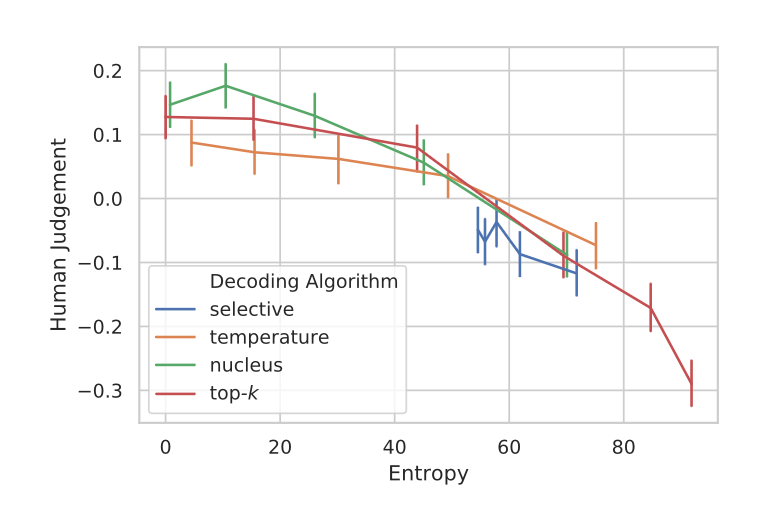
Here is what they found:
- When you want high diversity (creativity), all algorithms perform about the same. If you want the AI to be really wild, it doesn't much matter which rulebook you use.
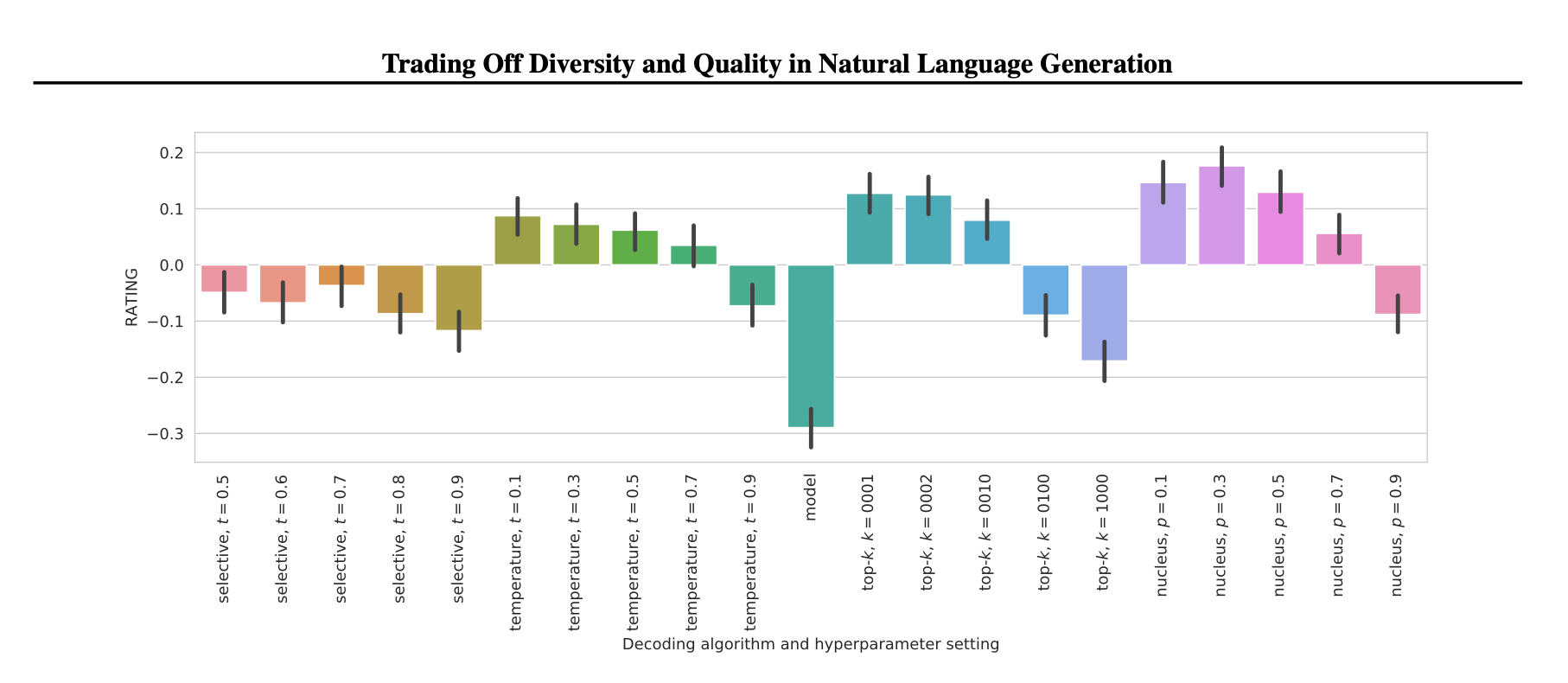
- When you care slightly more about quality, Nucleus Sampling is the champion. As shown in Figure 5 below (a bar chart comparing human ratings across all the different settings), Nucleus Sampling consistently beat the others when tuned correctly.
- The New Kid Failed. The researchers' own proposed algorithm—Selective Sampling—actually performed worse than the others. They realized that the older, word-by-word algorithms actually have hidden structural benefits that the global Selective Sampling algorithm lacked.
The Takeaway
Creating a chatbot isn't just about feeding it more data; it's about giving it the right rules to navigate the tightrope between being a boring robot and a chaotic babbler. Thanks to the massive human-judgement study in "01_Trading_off_Diversity_and_Quality_In_Natural_Language_Generation.pdf", we now have proof that the Likelihood Trap is real, and that dynamic rules like Nucleus Sampling are our best current tool for keeping AI both smart and interesting.